
Designing safely according to the provisions of
September 1, 2025
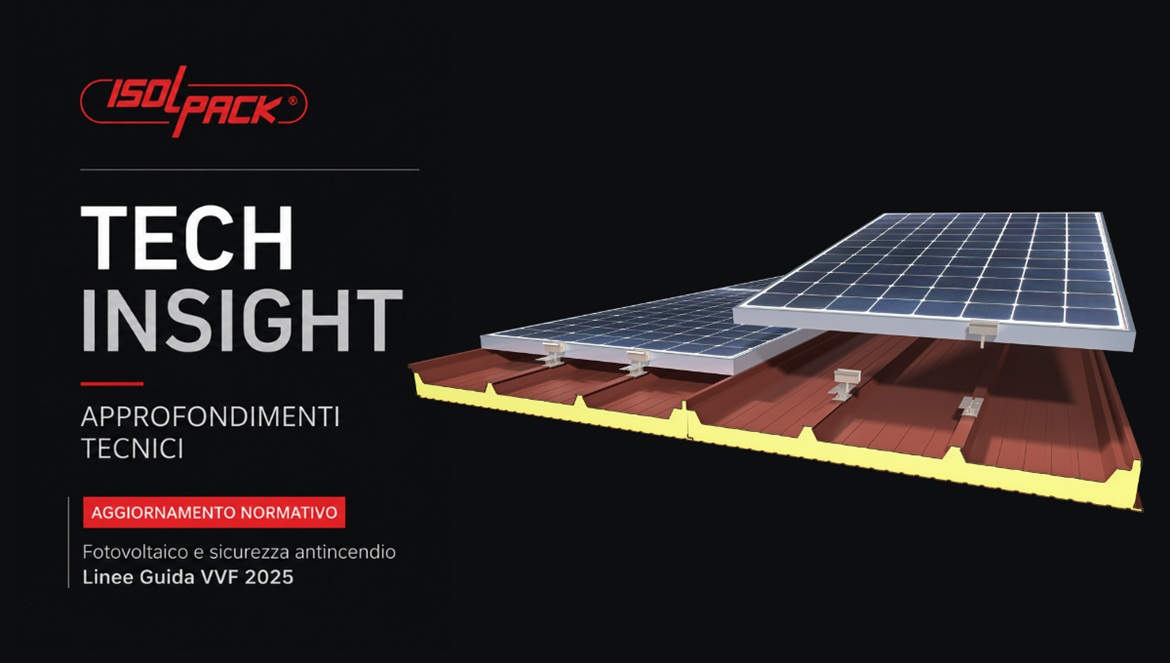
Almost one year after the provisions issued by the Italian National Fire and Rescue Service came into force on 1 September 2025, the design framework for photovoltaic systems installed on roofs is now clearly defined.
The purpose of the regulation is to provide a clear technical framework for integrating photovoltaic systems into roofs, establishing safety criteria based on the type of roof and the characteristics of the materials used. For designers, roofing contractors and manufacturers, this means one thing: understanding the different scenarios in order to select the most suitable technical solution from the design stage.
Safety does not, in fact, depend on the presence of the photovoltaic system itself. A correctly designed, installed and maintained system presents an extremely low fire risk. Compliance with the design requirements is what ensures maximum reliability of the entire system.
The three scenarios covered by the regulation
The provisions distinguish between three different installation configurations.
Case 1 – Installation on non-combustible roofs (Class A1)
This is the simplest configuration.
When the photovoltaic module is installed on a roof or final layer classified as A1, the solution directly meets the applicable requirements.
This category includes traditional profiled sheets made of steel, aluminium and stainless steel, which provide a naturally suitable substrate for the installation of photovoltaic modules.
The entire Isolpack range of profiled sheets is classified as A1 and meets the requirements for this type of installation.
Case 2 – Installation on roofs or walls with an EI30/REI30 fire-resistant element
When the roof or supporting structure does not consist exclusively of non-combustible elements, the regulation permits the installation of photovoltaic systems by providing a layer with characteristics of at least EI30/REI30, combined with a continuous non-combustible Class A1 layer. Photovoltaic modules of any classification may be used in this configuration.
This solution expands the available design options while maintaining high levels of fire safety.
Isolpack panels certified as EI30/REI30 or higher, designed for use on combustible structures as well, provide a solution that complies with this configuration and enable photovoltaic systems to be integrated in accordance with the applicable requirements.
Case 3 – Broof-certified roofs
The third scenario concerns roofs whose compliance is based on the reaction-to-fire performance of the entire system.
Here, the regulation introduces a fundamental principle: the assessment no longer concerns the roof alone, but the interaction between the roof and the photovoltaic system.
The photovoltaic module must have at least a Class E reaction-to-fire classification, while the complete system must provide the required Broof (T3) performance.
The Broof (T3) classification may be demonstrated through several methods provided for by the regulation:
Broof (T3)-certified roofs tested in a laboratory
Compliance is demonstrated through tests performed on the complete roof and photovoltaic system.
Broof (T3)-certified systems enable photovoltaic systems to be integrated in accordance with the applicable safety requirements.
Broof (T3)-certified roofs through CWFT
In certain cases, the Broof (T3) classification may be obtained through the European rules for Classification Without Further Testing (CWFT), provided that the system complies with all the conditions and construction requirements established by the relevant standards.
For designers, this represents an important opportunity: the ability to identify the most suitable technical solution for meeting the required safety standards based on the characteristics of the building and the photovoltaic system.
The Isolpack range includes Broof (T3)-certified panels and Broof (T3) solutions classified according to CWFT, offering systems that are already qualified for the integration of photovoltaic installations into roofs.
Where a specific fire risk assessment is required, the design process includes analysis and certification by a qualified professional.
From compliance to design quality
The provisions of 1 September 2025 have made even clearer a principle that now guides roof design: photovoltaic systems are no longer elements to be added at a later stage, but components that must be integrated from the earliest stages of the project.
For this reason, the choice of roofing system plays a strategic role. Assessing reaction-to-fire and fire-resistance performance from the outset simplifies the design process, prevents issues during the approval stage and enables the construction of safe, efficient systems ready for photovoltaic integration.
With a range that includes Class A1 profiled sheets, EI30/REI30-certified panels, and Broof T3 and Broof T3 CWFT solutions, Isolpack provides professionals with the tools required to address every configuration covered by the regulation with maximum design flexibility.
Altre news…
BIM and Building Envelope Design

Raw Materials Market Trends

EPD Certified Products by ISOLPACK

At the Service of School Buildings

Photovoltaic: Roof or Ground Mounted?

All Bonuses for 2023
Steel Market Updates
Ecology and Savings on the Bill
Technical Catalog 2022
